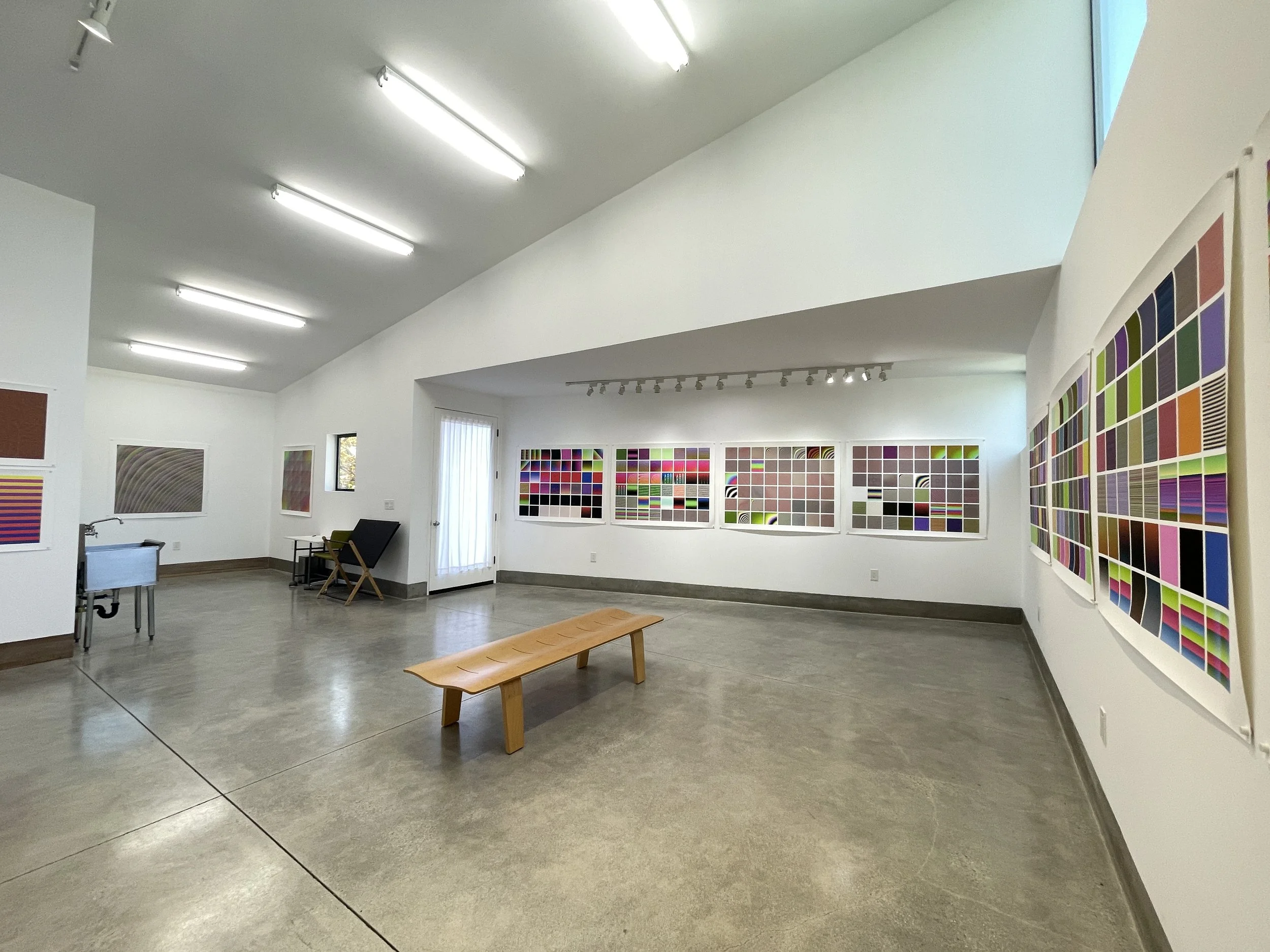
Owen Fox Coolidge Test Patterns
December 6th thru January 4th, 2025-26
Owen Coolidge (1998-2024) was an interdisciplinary artist from Los Angeles, CA with a bachelors degree in Computa<on Arts from Concordia University, Montreal, QC.
Motivated by his theoretical interest in how technology ac<vely shapes the process of culture, he uses programming, science, and other methods tradi<onally relegated to their respective disciplines to realize aritstic projects. His work has manifested itself in combinations of (digital and physical) sculpture, installation, photography, programming, and performance. Common throughout all his work is the critique of human exceptionalism and an indifference to formal artistic boundaries.
A record of process
All we know about Test Patterns is that the images were generated by feeding various values into a python script (or scripts) created by the artist. What we see is a series of panels that vary from simple stripes and color gradients to moiré-like interference patterns of seemingly infinite fractal detail.
Many of these panels are reminiscent of Op art, by the likes of Bridget Riley and Victor Vasarely. Owen’s apparent interest in this work is consistent with a generational reassessment of the movement that for long has been deeply unfashionable. Op art was in one sense, algorithmic art avant la lettre. It was also an engagement with the psychophysics of color and pattern perception. Both these qualities are present in Test Patterns.
If we look at the panels sequentially, we can discern an experimental process – many sequences begin with a simple premise, explored through variations, becoming increasingly subtle or complex. Then a new premise is explored. Then two previous results are combined, in increasingly complex ways. In some cases, aesthetic decision-making is evident, in other cases coding experiments descend into iterative vortices, giving rise to bewildering, emergent fractal-like detail, as graphical routines intersect in interference patterns.
Image Gen, the title given to the individual compositions that make up Test Patterns harks back to the deep formalism of Op art. It also references an approach to computer graphics that was ‘close to the machine’ - a long tradition of graphics coding that negotiates the relationship between computer code and visual output. Test Patterns is algorithmic, the image output in the panels is generated by calcuolatory procedures. This work was not generated by intricate longhand marking up and meticulous color mixing. Nor was it generated by twiddling knobs on the interface of a corporate ‘graphics package’. It is not ‘end user’ digital art. Python is a ‘high level’ programming language, itself written in the venerable ‘C’ language. It is at the peak of a pyramid of programming ‘languages’ that build one on another, with increasing sophistication and readability.
Test Patterns exploits the power of contemporary graphics coding, processing (and presentation) to pursue procedures across numerous iterations. Some results are eye- popping in their composition, others so subtle they seem almost monochrome. These panels are visual experiments. The larger project speaks of a transhistorical and critical overview of computer culture and computer image making.
Simon Penny, December 2025.