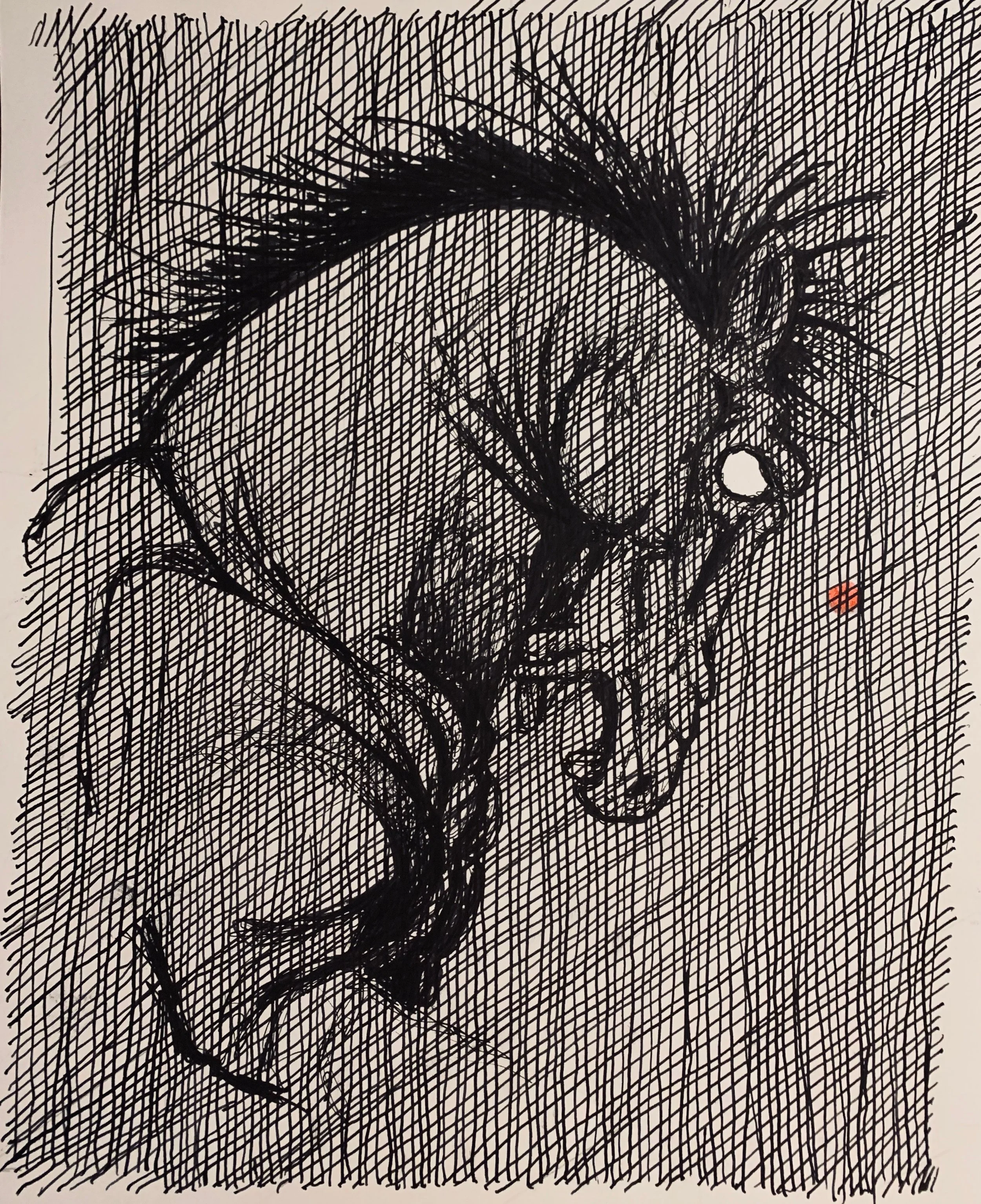
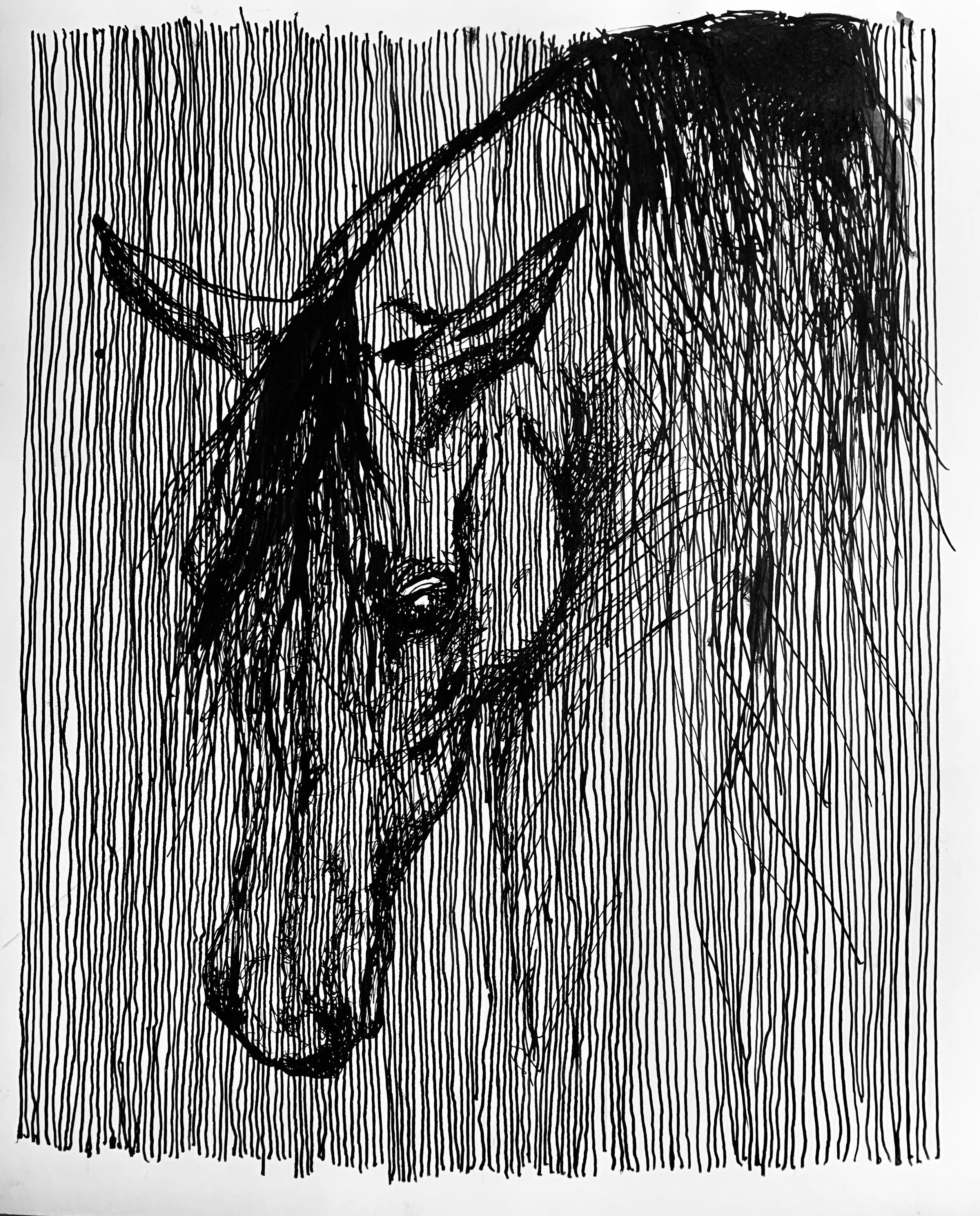
Sean Griffin HOMOTOPY
April 4th thru April 26th, 2026
Sean Griffin is a composer, opera director, and interdisciplinary performance maker whose work joins new music, theatre, extended vocal practice, and archive-based research. For decades he has been a leading figure in the contemporary music, performance, and art communities of Los Angeles and abroad. He is the founder and director of Opera Povera (est. 2010), a design and performance consortium through which he has written, directed, conducted, and produced new operas and intermedia works. Griffin’s projects frequently treat performance as an investigative apparatus—testing how “vintage” psychological models, discredited science, public policy, and institutional mythologies shape perception and social behavior—while developing performer-specific systems of physicalized vocality and task-based instrumental action.
Griffin’s theoretical and practice-based research operates under the framework of Oppositional Listening, a practice of attention directed not at what is foregrounded but at what is holding the foreground in place, encompassing five constituent practices: Apocryphony, in which a structure is organized around what the receiver’s body is already completing; Decrepiphilia, sustained attachment to what has withdrawn from active circulation; Apophatic Music Theory, in which the excess between what is stated and what becomes present is not a failure of analysis but the experience itself; Full Body Singing, in which the counterpoint between what the voice produces and what the body carries is the information; and Agogics, emphasis produced by duration, return, density, and residue.
Opera Povera’s productions, recordings, live performances, and designs have been presented at MoMA, the Brooklyn Museum, REDCAT, LACMA, the MAK Center at the Schindler House, the 56th Venice Biennale, the Museum of Contemporary Art Chicago, Ostrava Days (Czech Republic), the 2017 Ojai Festival, The Broad, and the Torrance Art Museum. At the 2018 Berliner Festspiele MaerzMusik, Griffin presented his 2008 libretto referencing Julius Eastman and premiered a new composition by George Lewis for vocalist Elaine Mitchener, with Lewis on electronics and Griffin on harp.
Griffin and performance artist Ron Athey have developed an extended collaborative relationship across multiple works. They co-developed and co-directed Gifts of the Spirit: A Queer Communion — an operatic work derived from Athey’s automatic writing and ritual performance practices, commissioned by the Mike Kelley Foundation and The Broad, and premiered in January 2018 at the Cathedral of St. Vibiana in Los Angeles. The work featured a hypnotized chorus of movers and vocalists ritually producing a spontaneous libretto performed live on stage. Griffin also served as performance developer and director with Athey for Salvatore Martirano’s L’sGA with the LA Philharmonic’s Green Umbrella Series at Disney Hall in March 2018, and directed Athey’s Acephalous Monster, which premiered at Performance Space New York in November 2018.
With Opera Povera, Griffin wrote and directed two of his own operas and directed six unique stagings of George Lewis’s opera Afterword, including at the 2017 Ojai Festival, the 2016 Huddersfield Festival, and the 2015 Ostrava Days Festival. The full opera was developed with co-direction from Catherine Sullivan and premiered at the Museum of Contemporary Art Chicago in 2015. In 2012, Opera Povera created an algorithmic staging of Pauline Oliveros’s landmark 1970 composition To Valerie Solanas and Marilyn Monroe in Recognition of Their Desperation at REDCAT’s Now Festival. In April 2020, at the outset of the COVID-19 pandemic, Griffin conceived and directed Full Pink Moon — a seven-hour streaming opera derived from Oliveros’s open-form Lunar Opera: Deep Listening For_Tunes, gathering nearly 270 performers across the globe for what was billed as the first Zoom opera. Timed to the evening of the full pink moon, the event was archived by the Library of Congress for its contribution to the arts during the pandemic.
Griffin’s broader activities include being the first curator to reconstruct and program a composition by Julius Eastman — twelve years after his death — for the Hammer Music Series in 2002. He received a Getty research grant for his work on David Tudor, and in 1997 conducted the West Coast premiere of Yves Klein’s Symphony Monotone.
For over a decade, Griffin collaborated with visual artist Charles Gaines, arranging, orchestrating, recording, and performing Gaines’s Manifestos 1 & 2 and related sound-text works with Opera Povera at the Hammer Museum, REDCAT, MoMA, the MAK Center at the Schindler House, the 56th Venice Biennale, and the MCA Chicago. That collaboration began after the two met during the creation of Snake River (2005), a two-channel video and music installation with artist Edgar Arceneaux at REDCAT.
Beginning in 1996, Griffin has maintained a long collaborative relationship with artist and filmmaker Catherine Sullivan. Together they have created theatre works, operas, and installation-based film projects including The Chittendens (Tate Modern; Metro Pictures, New York), The Resuscitation of Uplifting (Tate Modern’s World as a Stage exhibition), Triangle of Need (Royal Academy of Arts, London; Smart Museum, University of Chicago; EMPAC), and Ouija!, a movement theater work with Yohangza Theater Company based on Ibsen’s Peer Gynt, presented at Festival BO:M in Seoul. Sullivan co-directed the development of Lewis’s Afterword with Griffin during a Gray Center residency at the University of Chicago, where they also co-taught “Improvisational Dramaturgy” with George Lewis as part of the Mellon Fellowship for Arts Practice and Scholarship.
Griffin created an internationally recognized body of small-scale devised percussion theatre works with Taiwanese-Canadian percussionist Aiyun Huang, resulting in a series of percussion and technology experiments including early use of video scores employing international media and pop-culture sources. Mexican percussionist Iván Manzanilla joined Huang in premiering Griffin’s well-known composition Pattycake in 2001. Griffin and Huang also co-directed How to Draw Like Animals, a 12-channel coordinated live video stream presented from the University of Toronto in October 2020.
Griffin is a prolific visual artist whose work includes three complete remakes of Goya’s Los Caprichos, experimental notation designs, and assemblage-based set designs and installations that activate photography archives and historic object collections. Exhibitions include On Drawing On at the Gray Center, University of Chicago (2022); Drawn From a Score at the Beall Center, UC Irvine (2017–18); and The Space of a Moment to Measure at FOCA, Los Angeles (2017). He has worked closely for years with costume designer Stacy Ellen Rich.
Griffin holds an MFA and BFA from California Institute of the Arts (CalArts) and a PhD from the University of California, San Diego (UCSD). He has taught at UCSD, CalArts, the Gray Center for Arts and Inquiry at the University of Chicago, and the University of Guanajuato (Campus Irapuato-Salamanca, Mexico), where he served as Associate Professor and launched the Digital Arts Program.